




Filler / Botox Dermal Fillers & Botox in Seoul
Enhancing your natural beauty
through personalised facial design
Experience natural-looking, well-balanced filler and Botox results through
BAUS Clinic's personalised design approach and refined techniques.
Fillers are non-surgical injectable treatments that use hyaluronic acid,
a biocompatible substance, to restore volume and improve wrinkles.
As the name suggests, a filler is a substance used to fill and replenish areas beneath the skin.
It is injected to restore lost tissue volume,
improve wrinkles and enhance facial dimension.
Fillers are non-surgical treatments that use hyaluronic acid, a biocompatible substance,
to improve wrinkles and restore volume in areas that have become hollow or sunken.


Filler
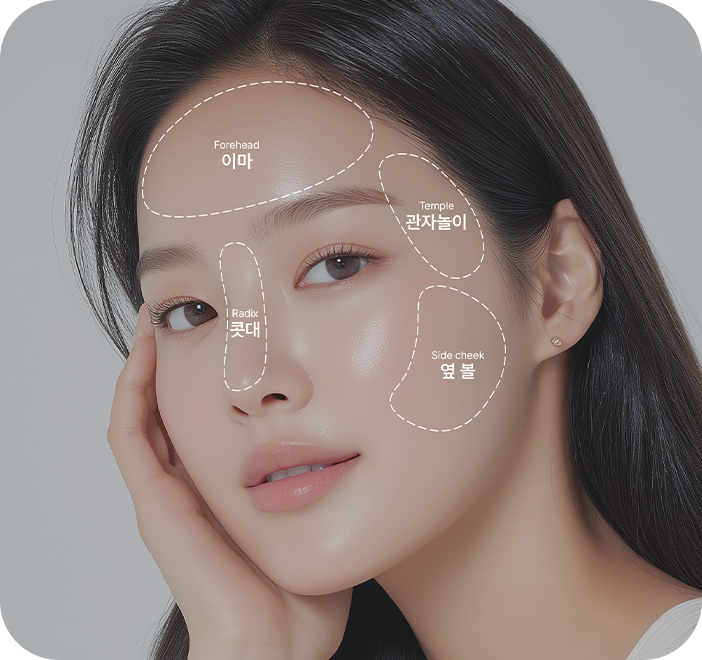
Treatment areas

Fillers are non-surgical injectable treatments that use hyaluronic acid, a biocompatible substance,
to improve wrinkles and restore volume in areas that have become hollow or sunken.
Botox is an anti-ageing treatment that
uses botulinum toxin to relax the muscles responsible for wrinkles,
helping improve fine lines and create smoother contours.
Botox works by inhibiting the release of acetylcholine, a neurotransmitter,
thereby suppressing nerve signals to the muscles. This relaxes the muscles responsible for wrinkles,
helping improve fine lines naturally and create smoother contours.

Types of Botox treatments
-
01
Wrinkle treatment
Improvement of wrinkles on the forehead, between the eyebrows, around the eyes,
on the nose bridge and on the chin. -
02
Targeted areas
Treatment for cobblestone chin, downturned mouth corners,
flared nostrils and a gummy smile. -
03
Skin Botox
Improvement of fine lines, enlarged pores
and skin texture. -
04
Jawline and temples
Reduction of the masseter
and temporalis muscles. -
05
Salivary glands
Improvement of the submental contour
and double chin. -
06
Hyperhidrosis
Treatment of excessive sweating in the underarms,
hands and other areas. -
07
Body Botox
Reduction of enlarged muscles in areas such as the trapezius,
calves, thighs and upper arms.
Frequently asked questions
-
Q1. Does Botox always cause resistance to develop?
No.
When Botox is used for cosmetic purposes, the incidence of neutralising antibody formation, which can lead to resistance, is reported to be approximately 1%.
However, the likelihood of developing resistance may increase when high doses are administered across multiple areas at once or when treatments are performed too frequently, even for cosmetic purposes.
Therefore, if ongoing treatments are anticipated, the use of a Botox formulation with a lower risk of resistance is recommended. -
Q2. How long do the effects of Botox last?
Botox treatments for wrinkle reduction typically last between 3 and 6 months.
For facial contouring treatments, such as jawline Botox, the effects generally last around 6 to 9 months.
When used to treat hyperhidrosis (excessive sweating), the effects may last approximately 6 to 9 months. -
Q3. How long do filler results last?
In general, the effects of filler treatments can last anywhere from several months to over a year, depending on the treatment area.
Areas with greater movement, such as the lips and nasolabial folds, tend to have shorter-lasting results.
In contrast, fillers in the anterior and lateral cheeks may last 1 to 2 years, while fillers in areas such as the forehead may remain for 5 years or longer.
At BAUS Clinic, we use cannulas instead of conventional needles to deliver treatments with greater precision,
helping minimise bruising and swelling while achieving natural-looking, even results.
-
 Technique
Skilled cannula techniques by our medical team
Cannula treatments require refined injection techniques.
Our medical team carefully selects the optimal injection points
and depths for precise product placement. -
 Balance
Treatment following personalised muscle assessment
We carefully assess each individual's muscle development
to achieve the most natural-looking
and well-balanced Botox results. -
 Combine
Can be combined with Sofwave and Ultherapy
Combining cannula-based Botox treatments with lifting procedures
allows for more refined V-line contours
and enhanced anti-ageing results.
(Q&A)
Frequently Asked Questions
- Q1. How are fillers and botulinum toxin injections different?
- Fillers inject hyaluronic acid to restore volume in hollow areas and improve wrinkles, whereas botulinum toxin (the injection commonly called Botox) blocks the release of the neurotransmitter acetylcholine to relax the muscles that cause wrinkles. Fillers are therefore mainly used for hollowing and volume, and botulinum toxin for expression lines and muscle contours.
- Q2. Where else is botulinum toxin used, apart from wrinkles?
- Besides forehead lines, frown lines and crow's feet, it is used to reduce the masseter (jaw muscle) and temporalis muscles, for a dimpled chin, downturned mouth corners and a gummy smile, as a skin treatment (fine lines, pores and texture), for injections into the salivary gland (submandibular gland) to refine the line under the jaw, for underarm and hand hyperhidrosis, and for enlarged muscles such as the trapezius and calves. Dose and injection points differ by area and are decided after checking the muscles.
- Q3. How does botulinum toxin for a square jaw change the jawline?
- Botulinum toxin is injected into a well-developed jaw muscle (masseter) to reduce its activity, so that over time the muscle becomes thinner and the jawline looks slimmer. An analysis of randomised controlled trials reported improvement in muscle thickness and prominence compared with placebo, but results varied widely and the optimal dose has not been established. Effects and how long they last vary from person to person.
- Q4. How is cannula filler different from needle filler?
- A cannula is a thin tube with a blunt tip, and BAUS Clinic uses a cannula instead of a needle to reduce bruising. In a comparative study of under-eye filler, the cannula resulted in somewhat less bruising, while a fine needle allowed more precise placement. The medical team chooses the appropriate method according to the area and depth.
- Q5. Are there side effects after fillers or botulinum toxin?
- Redness, swelling, bruising or pain may occur at the injection site; these are temporary reactions that usually settle within a few days to a few weeks. Depending on the injection site, botulinum toxin may cause drooping of the eyelids or brows, an unnatural feeling in facial expressions, or a feeling of weakness when chewing. With hyaluronic acid fillers, side effects requiring treatment, such as severe swelling, have rarely been reported, so your medical history and skin are checked at consultation before treatment. If you notice any unusual symptoms, please visit the clinic straight away.
References
- Adverse Events Associated with Hyaluronic Acid Filler Injection for Non-surgical Facial Aesthetics: A Systematic Review of High Level of Evidence Studies
- Needle versus Cannula to Treat Tear Trough: A Prospective Study Comparing both Methods
- Efficacy of botulinum toxin for masseter muscle hypertrophy: A systematic review and meta-analysis
